Busy Schedules Happen
Busy schedules happen, and business calls. In order to care for our health and wellbeing, we sometimes have to work in training around life's many hurdles. My approach when chaos knocks: get in what I can when I have time; if that means 15 minutes here and 15 minutes there, so be it. Training is ingrained in me, and it's a part of who I am. Do I have it easier than many? Sure, I'm a strength and conditioning coach who has access to equipment. But we all can take measures to squeeze in a few minutes of fitness. Perhaps it's 5 minutes of sit-ups before a business call; or maybe it's 10 minutes of push-ups and air squats during an afternoon break. The point is, time can be made. (I can hear the naysayers now: "that's being obsessive." I disagree. It's caring for longevity; it's catering to self-obligation; it's not letting the demands of daily activities throw me wherever it wishes. It's not just physical, either, it's for my mental health, too. Training helps me with stressors and anxieties that creep in during a week; there are alternatives to working out, but those are paths I don't want anything to do with.) Time is a commodity we can't gain more of. Do the best you can with the time you've been given.

Drivers Of The Squat
The Squat: What's going on? How do we drive up all that weight?
(Below the surface, yes, there's much more happening: knee flexion; downward forces; proper alignments; etc, etc., etc. Heck, what are the traps doing besides being a shelf for the bar? These are all nuances that will be discussed later, but for this picture's purpose, we're illustrating the engines that drive the machine.)


Training Is Like Tanning
Training is like tanning. Let me explain.
(Before going any further, I want to write that I did not create this analogy. This has been stated several different ways by a number of different people.)
Summer is here! So naturally, it's time we regain that golden brown look. Let's catch some rays! But what's the best way to optimize our time spent in the sun?
Day 1: Ambition has gotten the best of us. Instead of easing into it, we went all out. One hour spent on our front side, and one hour spent on our back side. Two hours total! When coming inside, we find we're red as a lobster. And we're already sore! Day 2, day 3, and day 4 are unbearable. We can hardly move, let alone go out in the sun again. Luckily, day 5 and day 6 allow some reprieve. We give it one more day, but we're ready to get back after it.
Day 8: The "tan" we had hoped to acquire went from red to flaking, and now we've peeled everything off. We're back to square one. We won't make that mistake again! This time around, we've decided to go outside for 20 minutes -- 10 minutes front side, and 10 minutes back side. When going inside and looking in the mirror we see a nice shade of color. A success! The following day we notice that we're not sore, either. Yes! We need to keep it up, but we don't want that soreness we received after Day 1. No way. We'll wait a few more days to play it safe. Day 9 we lay low.
Day 10: 10 minutes and 10 minutes was successful, so we'll do it again. Smart, right?! We lay low the following day, and we also notice we're a little darker. Another win! Let's stick with this strategy.
Day 12: 10 minutes and 10 minutes.
Day 13: No sun.
Day 14: 10 minutes and 10 minutes.
Day 15: No sun.
Day 16: 10 minutes and 10 minutes.
Day 17: No sun. But a problem has emerged. We're not seeing *any* more color. Nothing. We're no darker than we were on day 10. Huh? I thought we had a good strategy in place. What's the deal?! Back to the drawing board.
Day 18: We have a base -- something to now build off of. Today we're spending 12 minutes and 12 minutes. 24 minutes total seems to be about right. The next day we appear to be tanner. Great! No sun on day 19, though.
Day 20: 15 minutes and 15 minutes. We're even darker! It's working. (We contemplate switching things up and using a front-side day followed by a back-side day followed by a no-sun day, *which would work*, but we have a plan in place so we'll see it out.)
Day 21 and Day 22: We've been getting after it, so two days off in a row might do us good... And guess what, it did! All the time spend accumulating sunshine is paying off. We're now over three weeks in, and despite an early setback, we're tanner! Week four will be promising!
By now, I think you get the picture. Training is like tanning. If we want to get strong, build muscle, lose weight, or improve performance, we must do so one day at a time. We can't capture everything we want in one training session. We also can't be scared of the work required to make progress; doing the same thing every so often will leave us spinning our wheels -- without progress. A program must be put in place (and there are a number of great ones out there!). The plan must build upon itself weekly, incrementally increasing in difficulty. That's how we get results! Sure, it's much more complex than this, and nuances line progression, but the building blocks of success are simple. Plan + Progressive Overload = Results.
Happy tanning ... I mean training!
"Knees out!"
"Knees out!" One of the most widely used cues in lifting. It is especially utilized during the squat.
But why knees out?... Injury prevention. Of course! But let's take a deeper look.
The knee is the largest joint in our body; it is a complex system composed of ligaments, tendons, bones, and muscles. Our knees enable movement, and in order to move well throughout our life, the system needs to remain healthy.
When squatting, many people have a tendency to let their knees collapse. (See the picture surrounded by red.) When our knees fall inward, they are compromised. In this position, called valgus, we're more prone to both acute and long-term damage -- ACL tears and patellofemoral pain syndrome (runner's knee or jumper's knee, to be less specific) are a few commonly seen valgus-related injuries.
If a large enough force were placed on an internally rotated knee, acute damage may occur. Think: a sudden change of direction after moving at a high speed while playing soccer; or landing from an elevated position. If a number of small forces were placed on an internally rotated knee, chronic damage may occur. Think: a runner or walker who puts on mile after mile of poorly executed steps; or a businessperson who regularly climbs several flights of stairs.
As for the squat: we definitely don't want to cause harm to the knee (or any bodypart for that matter) during the exercise. So there's one reason for the "knees out" cue. As for the other reason, well, we want to properly build strength around the joint so that when every day activities ensue, we're better able to withstand the stresses placed upon the knee. (This is what we call "functional fitness.")
(I can hear the "squatting-is-bad-for-your-knees" crowd right now. This unfortunately ill-informed and ignorant number of people are doing themselves a disservice. A biomechanically efficient, properly executed squat performed on healthy knees is not a bad thing. It's a good thing! In fact, it can easily be argued that it is foolish to not squat, and that when done correctly, the squat improves the knee and helps with longevity! Ok, rant over.)
With stronger hips, legs, and muscles surrounding the knee, we're able to not only lift better, but also handle life better. Walking improves; running improves; climbing stairs, getting off the toilet, standing up from a chair, getting out of bed, remaining upright (the list goes on and on) ... everything improves! And as for our athletes: by appropriately executing a strength-building tool, such as the squat, (1) motor engrams reinforce the right movement pattern when running, jumping, etc., and (2) the knee is more prepared for and better capable of withstanding a sudden change in direction or position -- added stress.
Win-win!
So, just remember, "knees out!" *They should mirror the feet.* (Knees that are too wide is a different issue meant for another story on a separate day). And keep improving on that squat. Your future self will thank you.

KEEP DOING WORK
I've been working with Johnny for a little more than a year. When we started training together he was pulling 315#, with straps, for a single. Today, he's pulling 350# for 5 reps, strapless! Dude is becoming an oak tree. Proud of you, brother! Keep doing work...
Love hearing from y'all! Keep the messages coming.

New Stimulus & ROM
Question: I am an avid biker, so I use my legs quite intensely. Nearly daily, in fact. A week ago I squatted; I was incredibly sore, for nearly the entire week. What's the deal?! I use my legs ALL the time!
*Followup questions: Do you squat often? If so, did you perform an unusual amount of volume? More than you're accustomed to?
*Followup answer: This was my first time squatting in nearly a month.
Answer: Any new stimulus placed upon the body will usually result in some type of soreness. Since you hadn't squatted in a month, the novel movement shocked your system. More importantly, though, although you use your legs "intensely" on a regular basis, you're not taking them through a full range of motion -- the range of motion a squat would take your lower extremity through. When you bike, your knee and hip joints remain in a somewhat flexed position. Because of this angle, your muscles aren't activated while stretched; you're used to hours of concentric contraction. (Check out the Concentric-Eccentric video from a few days ago.) When you squat, you've performing a contraction that is not normal to you. Because you're not used to the stretched state while under load, you experienced trauma to your muscle fibers. This could have happened with something as simple as 2 sets of 5-8 reps. Someone who only executes the leg extension then performs a squat for the first time in a month would experience the same result, FYI. In the future, I would incorporate more squatting, and other compound movements into your routine. The increased strength you gain will give you just a little more force on each revolution as you pedal. And you won't be as sore if you get into a more regular lifting routine.
Arrow vs. T
When taking a bird's-eye view of the Push-up and the ground portion of the Burpee, one's elbows should point back and to the side as opposed to directly to the side. The form should take that of an arrow, not that of a T. Why is this important? When the humerus (the top portion of the arm) extends directly to the side of the shoulder -- T form -- the rotator cuff tendons can get caught between it and the acromion process (a bony ridge on the scapula). When this happens over and over and over again during the exercise's full range of motion, wear and tear begins to accumulate on the tendons. In time, damage can occur, leading to possible surgery and reconstruction of the shoulder. Not good! So give your shoulders a break. Think "arrow" when you're executing these push movements.

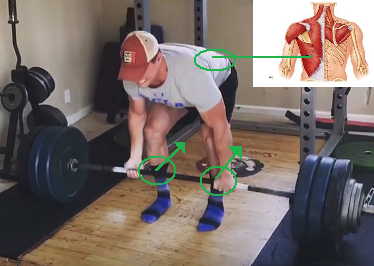
Lats and Deadlifts
A vertical bar path lining the middle-foot is the ideal movement for barbell lifts. How do we maintain this relationship in the deadlift? By utilizing our lats. That's right! It's our lats' job to pull on the arms, which anchor to the weight. By contracting this powerful muscle mass, the iron is able to hug the shins and thighs as it travels up to the hips. During the lift, it's important to maintain the bar-body connection for optimal execution; if any relaxation occurs, proximity to the body (and force transmission through the trunk) will be compromised. So flex those lats and lift strong!
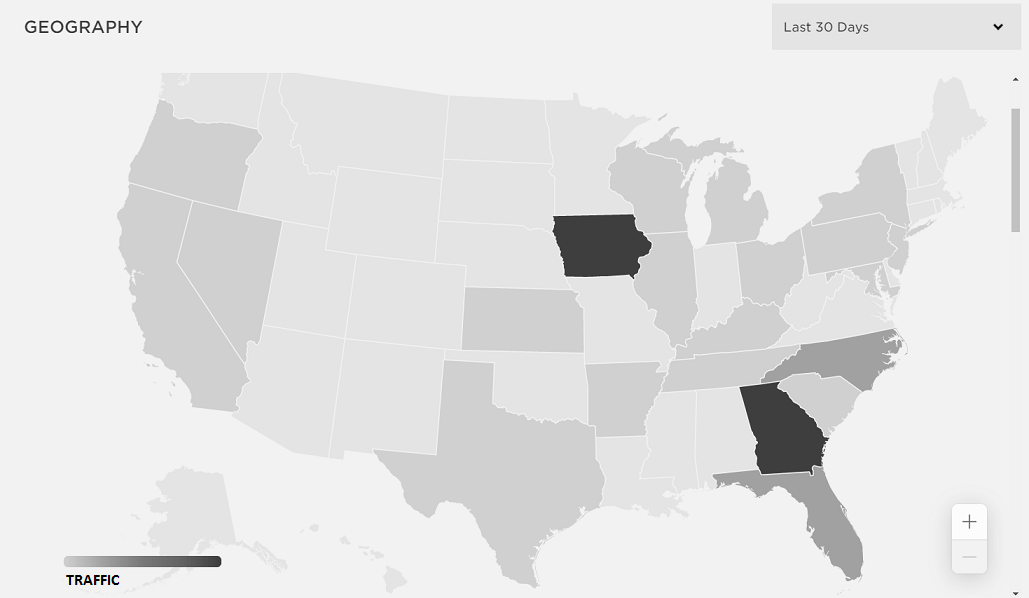
5 Years Later ... THANK YOU!
What started as Farmer Fit in a small Italian restaurant in Los Angeles five years ago, has evolved into Farmer Gym and strong bodies being grown nationwide. Thank YOU for YOUR support and for the work YOU put in! I'm excited to see where the next five years takes us! #dowork and #growstrong!
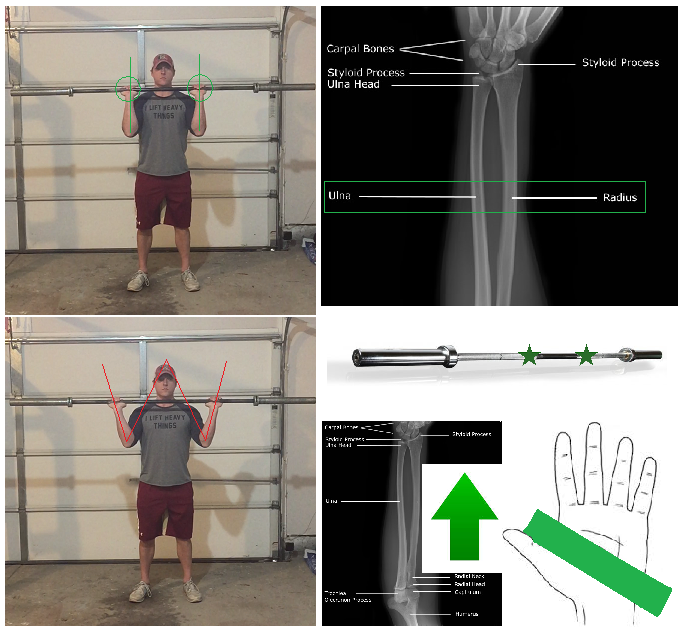
Overhead Press Hand-Arm Position
Before taking the bar out of the rack for the Overhead Press, be sure to have your hands and arms in the right position. The load should sit on the heel of your palm, placing your forearms directly under the bar; this puts the elbows just in front of the bar when looking down from above. When the bar rests on the meat of the hands which lie directly over the forearm bones, the ulna and the radius, you are able to better provide force to the weight and drive it upward. When the forearms are angled, the Overhead Press is not maximized due to poor leverage -- the weight, although being propped up by the forearms, hovers over open space without a pillar perpendicularly lining the bar to help fortify and drive it toward the ceiling. Although grip width will somewhat deviate based upon one's anatomical structure, the proper grasp is usually just outside the shoulders; this is more narrow than that of the hand placement on the Bench Press.
Deadlift Q&A
Question: my lower back (the lumbar region) tends to round whenever I perform heavy deadlifts. What should I do?
Answer: a few things immediately come to mind. (1) Think "lift my chest up" when executing the deadlift. This cue forces you into a less arched position. Don't overcompensate by hyperextending your back, though. (2) You may have weak erectors. As a result, you should try strengthening your lower back. There as several great exercises that help with this. Good mornings and back extensions are two great options! (3) Maybe you're using too heavy of a weight for your sets. Backing off the intensity until your body is better prepared to handle the load could also be an option.
I would begin with (1) and (3) and see how it goes. If you still deal with the issue, move to (2).
Happy deadlifting!
GOALS
I want to stop smoking. I want to run a 10k in under an hour. I want to Bench Press double my bodyweight. I want to lose 25 pounds...
If your "want to" is to become reality, you must create a *definable* goal. "I want to lose weight" or "I want to lift more" is not a definable goal. Sorry. It must be specific.
By creating a definable goal, you're committing to something significant -- you're pledging to yourself. Responsibility relies upon you, and you're not going to let yourself down, right? Yes, others can help along the way, but in the end, the goal rests upon your shoulders.
Now, the important question: How do I reach my goal? How do I stop smoking? How do I lose 25 pounds? The answer: you must take action, and you must follow a process.
Iron cannot be pressed without a detailed plan. Fat cannot be burned without taking calculated measures. To reach the end-game, your goal, you must create small, manageable goals along the way to the finished product. You have to see yourself finishing several small steps along the mountain's path in order to make it to the peak.
Every week or two, gauge your progress. How are you doing? Are you making progress? Are you becoming frustrated? (This is common. Don't let frustration derail you!) If you need to make adjustments, that's fine, but just remember why you started. Know that you're after something that *will* change you and your frame of mind. It takes work. Period.
Two weeks will become a month. A month will become two. Before you know it, you're half-way through a year and you're on your way; you're on your way to climbing your Everest, to accomplishing what it is you set out to finish.
Life will continue its course no matter what it is you do. But, life can become a much more beautiful thing if you set your sights on and reach something desirable, something admirable, something that will make you a stronger person.
So set your sights. Make your goal. And, as always, #dowork!
#dowork #growstrong
Mark, a good friend, decided to start the Farmer Gym training journey several months ago. First, he purchased the Farmer Gym Strength and Conditioning Manual, then he got the Farmer Gym Way. He and a few training buddies have been hammering out work ever since! Last night I received this message: "We still have a couple more weeks [to make it through book number 2, the Farmer Gym Way]. I can tell you my 5 sets of 3 are at or above my 1 RM from the first book." Mark's 3-rep weight has now surpassed his former 1-rep max! And it should be noted, he was already a strong dude, and he saw solid numbers after book number 1! That's doing work. Props buddy, and keep at it!

EnduraStrong
3 hours and 20 minutes into the workout...
EnduraStrong:
1,000 Kettlebell Swings @ 55#
1,000 Burpees
26.2-mile (Marathon) Row
Time: 7 hours and 45 minutes.

March Fitness
In just over a week, March Madness goes down! Here's our version, for those who like to wager on fitness. instead of being filled with teams, we've replaced each seed with exercises.
How it works: if, for example, the 1, 9, 12, 4, 6, 14, 7, and 15 seeds win from the upper-left part of the bracket, you would have 15 reps of each accompanying exercise. That's 120 reps from the 8 different movements. Note, 2 of the 4 parts of the bracket go on Thursday, and 2 of the 4 parts of the bracket go on Friday; therefore, you will have 240 reps on one day, and 240 reps on the following day.
Winners moves on. When the winning seeds plays again, the reps are increased. As you will see, Round 2 consists of 45 reps per victory. Play this round just as you did Round 1. Execute your reps according to the victorious seeds.
And so on and so forth, until there's a champion! (Hopefully the 1 seed, Burpees, doesn't take the crown.)

Life Gets Heavy; Life Gets Uncomfortable
The Italian Stallion said it best: "The world ain't all sunshine and rainbows. It's a very mean and nasty place and I don't care how tough you are it will beat you to your knees and keep you there permanently if you let it."
Life gets heavy, and it can be very uncomfortable. This is something we must accept in a hurry, and if we don't, we're in for a world of hurt, a world filled with letdown after letdown. At Farmer Gym, we like to think of our workouts as a microcosm of life. Comfortable is not of us; pleasure isn't what we're about; and the word easy should never be uttered in our work. By wielding cold, heavy iron, and by constantly moving and lifting, we prepare the body and mind to withstand the demands of being alive.
If you quit here or decide to take the easy way out, what will you do when life heats up? I can speak from personal experience. I've chosen to quit and walk away from life's demands; the easy way out is a path I've taken many times; and succumbing to non-beneficial pleasures is a constant battle. Life is hard. But through the demands of pressing and pulling, and via the fire of fitness, we hope you can be better prepared -- both bodily and mentally -- for whatever is thrown your way.
No, we're not for everybody; in fact, we're not for many. But if you're up for a challenge, and you're able to withstand harsh conditions that will test your resolve, well, we might be the right kind of uncomfortable fit for you.
(Life can also be a beautiful thing, this we know. And our bodies, through the suffering and test of will, are prepared to enjoy the pleasures the Good Lord gives us.)
Will Women Get Bulky If They Lift
My former client and great friend, Adreiane Esteves, made a fantastic Facebook post last night in reply to a question she often gets asked: If women lift weights, will they become bulky? Her reply was spot on. “A woman’s body doesn’t produce enough natural testosterone to look bulky. Don’t worry about weight training, worry about the diet!” Bingo! Adriane hit the nail on the head. (By the way. Adriane knows a thing or two. She has won a number of trophies for various bikini and figure competitions.)
So, being the nerd I am, I wanted to quickly dig into this a little more and shed some further light on the female-lifting-bulkiness topic.
To further elaborate on Adriane’s comment, women simply don’t have as many anabolic homones (muscle building hormones) floating through their system. It’s a physiological fact. On average, the adult male creates 6-8 times as much testosterone than that of an adult female. That’s a lot! Keep in mind, testosterone is a primary driver of muscle creation.
Let’s take this a step further: look around gyms everywhere. Do you see the time and effort men put into “looking big?” It takes them years to pack on muscle, and that’s only if they train and eat just right. And, some of them (*gasp*), even take performance enhancing substances to get where they are! A few of them add testosterone, or other anabolic hormones, to further help increase size. So if a person is already at a muscle-producing disadvantage, and said person doesn’t partake in supplementation, adding “bulk” is incredibly difficult.
Before going further, I want to answer a quick question. Can a female add bulk? Sure. And if you’re one who wants more size, more power to you! Go get it. What we’re saying here, is, it’s more difficult to do than the male counterpart – much more difficult.
I did a Google search on women, lifting, and bulkiness, and I very quickly found these three statements … among a plethora of others.
“…it is unlikely that lifting weights will make women appear masculine. Jan, a personal trainer, who can push 320 pounds on the leg press machine and bench press 135 pounds, explains that she lifts weight because ‘With more muscle and fat, I burn more calories. It also shapes your body better than anything else going.’” (Femininity and the Physically Active Woman)
“…weights have significant health benefits for women. Don’t worry – you won’t end up looking like Arnold! Women generally have too much estrogen in their bodies to build large amounts of bulk.” (American College of Sports Medicine)
“The common fear that women will become too bulky or large with strength training is not physiologically possible and should not dissuade women from engaging in this mode of exercise.” (National Center for Biotechnology Information) *It should be noted, this sentence states “will”, not can; as we mentioned before, if you’re goal is to pack on size, it can be done. It’s just going to take much more work, with altered nutritional planning, and possible supplementation.
So, there you have it ladies. Listen to Adriane, and have at the weights. Crush them! Lift big! Trade in the plastic weights for iron. It's the excess cupcakes and pizza that should be feared, not the deadlits, squats, and overhead presses.