
Weights are king
Running is good. Biking is good. Swimming is good. Skiing is good. Walking is good. *Fill in your favorite mode of cardio—it’s good.* But no type of cardio will change and sculpt your body remotely close to that of strength training. If you want to change the way you look, lift the weights! (Oh. And weights do a lot more good than just make you look better, FYI.)
Relationships
For a friendship or a partnership to work, both parties must #dowork. Both people must try. A one-sided relationship may last momentarily, but over the course of time it will fall apart—no matter the effort of the one side. Similarly, our relationship between food and fitness is the same. In order to maintain our health and optimize our fitness, there must be a solid, balanced relationship. We can’t just insanely work out and eat like a jerk and expect long-lasting results. There must be effort in the gym and in the kitchen.
Obesity
When most people talk about obesity, they're not poking fun at the issue. And they're not judging an individual. When most people talk about obesity, they're bringing to light the harsh reality of a problem. (Again, this is not about the person. And if one is out to point fingers, he/she better first look him/herself in the mirror.) Obesity carries with it consequences. As The Mayo Clinic states, "Obesity is a complex disease..." Obesity carries with it the likes of diabetes, heart disease, stroke, and many associated cancers. The disease, too, increases the risks associated with illnesses like Covid. Maybe you've heard of it? So why do we "health" and "fitness people" bring the O word up so much? We want to help. We want to help improve the morbidity rate that is associated with obesity; we want to help improve the day-to-day livelihood of those who fight obesity; we want to help alleviate the societal ramifications that comes with obesity. Bringing to light a problem is not bad; in fact, it can be a great thing. Bringing to light a problem is about beating the alternative...the alternative of not being. #dowork, your life depends on it.
Open Hips
Extension: good.
Overextension: bad.
In the fitness world, you often hear the term open hips. What does it mean, though? In a simplistic term, it's the point at which your hips come forward, and your body "opens" to an upright position. A key aspect to this open-hip phrase: your spine is upright and neutral; it is in an optimal position.
A problem: people often overdo it. They hyperextend their back in hopes to compensate for any possible missed opening of the hips. Don't do this. When this happens, the back—particularly, the lower back—becomes compromised.
Just stand up. That's open, and that's sufficient.

Build Your House
Carbs and fats help build the house. Protein is the house... Think of it like this: carbs and fats are the construction workers putting energy into the creation of the structure; protein is the lumber and bricks that eventually form the structure. The better you use your construction workers, and the more accurately you estimate your lumber and bricks, the more well-built your house will be.
For The Mind
Fitness does more than just sculpt one’s physique. It builds confidence and shapes character. It helps battle depression and fight anxiety. It’s an outlet for frustration and a tool used to boost one’s mood. Fitness benefits the mind far more than the body; it’s just the body that everybody sees.
Pace yourself
If you’ve been mostly locked indoors for an extended period of time (months), what would happen if you went outdoors when the temperature warmed up and you suddenly spent three hours in the hot sun? You’d get burnt. Fried, in fact! You’d then be miserable and most likely unable to “catch some rays” or spend any time outside for a long time to come. What should have you done? Slowly integrate yourself to the new stimulus. Instead of three hours, you should have spent 15 minutes here and 15 minutes there—working your way up to a longer period of time spent outdoors.
Similarity, our fitness operates the same way. If you’ve been mostly lethargic and doing no exercise for an extended period of time, what would happen if you went to the gym and crushed a multiple-hour workout? You’d get wrecked. And sore. Dangerously sore! You’d then be out of sorts and most likely unable to work out for a long time to come. And you’d probably be a little afraid of getting back to the iron. What should have you done instead? Slowly integrate yourself. You should have gotten a low-intensity, 15-30 minute workout under your belt. Rest a day or two, then do it again. Slowly working your way up in intensity and duration.
If any of this resonates with you, take heed. Pace yourself. Slowly integrate yourself to the stressors ahead. And if you have a trainer who wants to “throw you to the wolves” because he or she prides himself or herself on soreness, get a new trainer. He or she is not smart.

change your mindset
Change your mindset and trust the process: a lesson in fitness from college football.
Yesterday, my alma mater won the Fiesta Bowl, one of the top bowls in college football. This doesn’t happen; not at Iowa State University, a school historically not known for its football prowess. But as a friend texted me, “These aren’t your Grandpa’s Cyclones.”
What happened? Does Iowas State suddenly have Alabama and Ohio Stars talent? Nope. Was it suddenly given Texas money? No. What changed?
There was a change in mindset and a trust in a proven process. Matt Campbell, the Iowa State head coach, got his players to believe in their abilities and rid themselves of the excuse of mediocrity; he reinforced a message that allowed them to fully embrace who they are as players, ones fully capabale of succeeding. Would they suddenly become 5-star, elite athletes? No. But with they’re skill set and capabilities combined with a winning X’s and O’s formula, they could be winners. They could succeed. They could great!
They WERE capable of more. They ARE capable of more. And this is the very thing we need in our fitness walk: we need to rid ourselves of the excuses that so easily tangles us and believe in ourselves. We don’t have to be elite to succeed; we don’t have to have 5-star genetics. We simply must try our hardest to get the very most out of the abilities we’ve been given. Then, and only then, can we embrace a plan that works, thus catapulting us toward our goals. Toward success.
Believe in yourself. Find a plan that works. Trust the process. And #dowork.
Just Move
Something to think about: due to remote, at-home working conditions, many people fall short of their regular activity level. Because they’re not at the office, they don’t walk to and from parking lots; they don’t climb multiple flights of stairs to their office; they don’t “get a coffee” over break; etc., etc., etc. Sure, these people might not be missing workouts, but they are missing the extra calorie burn of excess movement. If this is you, be sure to set aside time to get up and move while working from home. For example: schedule a 15-minute walk every 90 minutes to two hours. Or, sporadically spend a few minutes knocking out some push-ups or sit-ups. Don’t underestimate the value to just moving!
This diet. That diet.
The Paleo Diet. The Vegan Diet. The Low-Carb Diet. The Dukan Diet. The South Beach Diet. The Atkins Diet. The list goes on and on and on and on and on... You can try whatever you want, but the problem with most of these is that you usually resort back to your old ways. Once you give up on your diet of choice, the LBs go right back on—many times you’ll put on more weight than your prior baseline.
Want to lose weight? Try this: eat in moderation. That’s it! Consume fewer calories while burning more calories. If you’re in a calorie deficit, you’re bound to drop weight. And what’s great about moderation? It’s sustainable! If you focus on fewer calories—consuming necessary food for daily functioning—you’re more apt to stay on track and reach your “magic” number. (With this approach, you don’t have to deny yourself of everything, which tends to be a plus.)
Training Mistake Q&A
Question: What’s one of the biggest mistakes you can make in your training?
Answer: Stopping because you don’t think you’re getting the results you want. This, in turn, leads to starting over. Stopping and starting over will put you back at the beginning, or at least at a disadvantaged position relative to where you should be.
There is no “perfect” plan. Sorry to bust your bubble. Yes, there are great plans (we think we have some pretty darn great ones at Farmer Gym, of course!), good plans, and bad plans. From my experience, most plans are at least good—or adequate—and get results. They will. It’s just a matter of sticking with it, executing it as prescribed, and putting in the work. In today’s click-happy, check-out-the-latest-gizmo culture, though, it’s easy to want to try a thousand different things. Especially if your friend just started this “crazy awesome” glute-smashing routine! Or if you think you should be seeing more from your work. But you can’t get caught in the trap; you can’t keep getting suckered into the newest fad and the hot new training. And you can't discount progress, no matter how slowly it comes. What you must do: STAY THE COURSE. Keep doing what you’re doing. Continue to chop wood. (The tree won’t fall if you don’t keep swinging the axe.) Once you’re done with the plan, that’s when you can try something new, something different—if that’s what you still want.
So, I guess my long-winded answer is this: the biggest mistake is the lack of discipline and consistency. Stay the course.
Simplistic Complexity
The body is not only very complex, but also incredibly simple. It consists of trillions of cells; miles of veins and arteries; and hundreds of muscles, bones, tendons, and ligaments. Through coordinated interactions, it functions, fights disease, and sustains our very being. Although complicated in its working, the body simply responds and adapts to what we give it. The stress, or lack thereof, we place on our body directly changes its structure. On one hand: if we lift weights, we grow muscle and become stronger; if we run, we lose fat. On the other hand: if we sit on the couch, we weaken; if we eat excess amounts of food, we fatten. Simple. Take care of the straight-forward variables, then the more nuanced inter-workings of the body will respond.

Start Somewhere
Start somewhere.
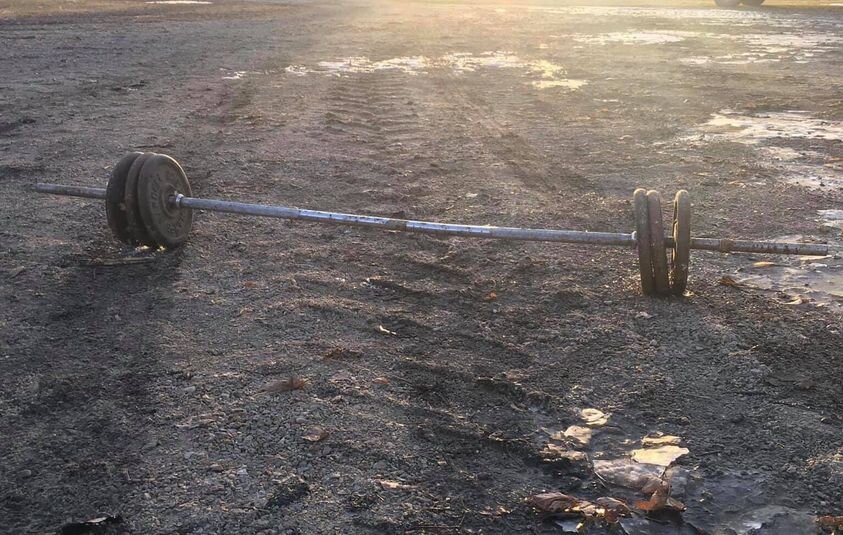
Seen here: my first set of weights. I still remember toting the newly purchased iron and walking it through the Mall of America—anxiously awaiting my first home workout.
Fast forward two and a half decades, I’m still working out at home. Sure, my setup has changed, but my love for the iron remains the same: I anxiously embrace the pain that lies before me, all for the sake of a stronger body and more resolved mind.
I don’t make it home very often, but when I do, you can guarantee that I’ll hit a workout with the 25-year-old steel. For me, it’s nostalgic; it brings me back to the lessons learned when I first began: consistently work—one rep, one set, and one workout at a time. Then let the process do it’s thing.
The most important thing for me, though, was taking that first step. Starting. And not looking back. That iron has followed me everywhere throughout the years—not just inside the “gym”, but also outside of it.
If I want something, I must work for it. I must be relentless in my pursuit. And when I fail—which I’ve done thousands of times—I must keep moving forward. But wherever I am, I know this: I had to start somewhere. I had to take the first step and purchase the weights
So if you’re reading this and you’re on the fence regarding something worth while, remember one thing: start somewhere. Whether it’s fitness, family, finances, faith—fill in the blank—just start. Then #dowork.
Weight Q&A
Question: When preforming workouts, what are the benefits of lighter weight and faster rounds vs. heavier weights and longer pauses and rests? What burns more calories and builds more muscle? How do you find the right balance? Should I go heavier and rest more often, or should I try to go unbroken as much as possible with lighter weights?
Answer: Great question(s)! A couple factors should be looked at, and, as always, everybody will respond slightly differently. But here is my advice: too light tends to be just a lot of conditioning, which is fine. Going a little heavier, though, will provide you with even more conditioning, as the body will have to work harder to move the weight. This, in turn, will burn more calories. The heavier weight will allow you to build more muscle, too. Heavier weight will cause more anaerobic activity, and your muscles will really have to brace themselves to #dowork. This can cause more breakdown of muscle tissue; and that, the breakdown of tissue, is how you build muscle (don’t forget the protein!). Here is the important thing: when going heavier, it’s imperative that you have good form throughout your movements. Form tends to break down when you’re tired and the weight is heavy. If you perform a workout at a fast-enough clip, go heavier. Basically, if it feels like an aerobics class, you’re not going heavy enough. Or, if you’re getting through every string of exercise without struggle, go heavier. (For example: if you have 40 prescribed Dumbbell Snatches, and you can easily breeze through all 40 without a break, you’ve probably not going heavy enough.) If, after going heavier, you find yourself once again going fast enough (while maintaining form, and while not being too sore the next day – that’s important, as you don’t want to be absolutely wrecked the day after a workout), go heavier again. Basically, if you ever find yourself easily making it through a workout from a muscle fatigue standpoint, you’re likely going too light.
The Objectivity of Fitness
It’s sometimes difficult to get two people to agree on a subject; differing vantage points lead to conflicted views. So one can imagine what it’s like to get nearly eight billion people — the world’s population — to come together on a topic. The beautiful thing about health and fitness: it’s objective, not subjective. There is no opinion (aside from the petulant CrossFit vs. Bodybuilding vs. fill-in-the-fitness-style arguments) on the matter. You either #dowork in the kitchen and the gym to get results, or you don’t. You either put in the time to reach your goals, or you don’t. There’s no middle ground. One reaps what he or she sows. Period. Excuses and contentions do zero good. Grappling the iron dictates everything.